“Just write every day of your life. Read intensely. Then see what happens..."Ray Bradbury on writing Ok, so there won't be a post everyday, but this is where I'll be sharing short stories about my adventures as an artist and student. Check back here for the latest updates by clicking the subscribe button below. To 'shop or not to 'shopThat is the question? Well, it’s certainly a question and not one about hitting the high street or eBay with my increasingly anxious credit card. It’s not intended to be a cheap rip-off of Shakespeare either, even if it looks that way. The ‘shop’ here is Photoshop, although other editing programs are available of course. For a while now, I’ve been reflecting on how my photographic practice has evolved over the past decade or so. I’m not talking specifically about the technical ability to shoot a picture, which has naturally had to change given the number of different old cameras I now use. Nor am I specifically talking about creativity, which is something that continually changes with whatever project I’m working on, as well as within my studies. When I refer practice here, I mean the complete process from concept through to finished photograph, which includes the murky area of post-processing. Post processing isn’t anything new. Since the early days of printing on photosensitive material, photographers experimented with a variety of elements in the production of a final image. Variation in the emulsion, processing chemicals, temperatures and times, produced different results, any of which might be the preferred look. By the time photo papers for printing had become mainstream, darkroom techniques to achieve the best possible outcome from the original negative had become quite sophisticated. Photographers would make a contact or test print which,in the case of the former, is simply laying a negative onto a paper and exposing through it. The resulting print would then be annotated with a marker pen with the areas of the image that needed adjusting in during the making of the final piece. Dodging and Burning became the techniques to lift shadows and retard highlights as the paper was being exposed. The former involved temporarily blocking the light falling onto the paper, thus lightening the area when developed, while the latter involved exposing an area for longer. Although I’ve never printed in a darkroom, I remember watching my Dad waving his hand over the areas that needed dodging, like some kind of magician waving a wand. You couldn’t see the results until the paper was subsequently developed in the chemical baths, so it was all a case of judging the timing in both techniques. The real skill was judging how long was too much and obviously how short was too little. When digital technology became the norm, the need for these skills largely disappeared with the decline in film photography, however they do survive today in the many software packages used to carry out post-processing. Like all technology, the developers continually push for more and more tools and features for their digital users. That is the purpose of this post, to share my thoughts on how much is too much and what is just right for my personal taste. A few weeks ago, a photography Instagram account appeared in my stream (shouldn’t be a surprise to anyone) and the image being shared was a dramatic, contrasty portrait of a young woman. It was certainly an expressive piece of work, but immediately clear to me that it had been processed to the point where it was no longer really a photograph. Ever since my project on internet trolls last year, I’ve found myself automatically looking at the comments on these kinds of posts, as if I instinctively know that these morons will have something unkind to say about them. Sure enough, there was outrage (not too strong a word) at the fact that the picture was ‘not a photograph’. This image was an "Artificial Intelligence creation" at best, or a "clumsy attempt to be interesting" at worst. Their views were that photography was a pure and truthful medium, which in actual fact couldn’t be further from the truth. The act of transferring what is in front of the lens onto the sensor or film is scientific enough, but that certainly does not make it truthful. As well as manipulating the technology as I mentioned before, photographers have pretty much always done the same to the subject, setting, lighting, context etc to make an image that they visualise. They may want to portray something honestly, but truth really doesn’t come into it. I wasn’t surprised by the angst about the picture I was looking at, because I am a traditionalist at heart and my own work tends to be traditional in style. However, the use of post processing in this case was pushing the aesthetic into what I consider the digital art space. Although art is a complex concept to define, most experts agree that it’s an expression of human creativity that evokes some emotional response in the viewer. To this end, the picture was a valid artwork as it grabbed my attention and invoked a sense of wonder about it, but admittedly I felt it had less in common with photography than perhaps a painting would have. It stuck me that the anger at somehow contaminating the medium of photography seems to stem from the use of technology to hide errors or improve on something that wasn’t done properly in the first place. Did this digital art image start out as a poorly executed portrait? As I said, the tools and features of most post-processing software does suggest that you can make a bad image better and, if so inclined, make something completely different from it.
This guy (guilty as charged) thought he was being gritty and interesting in 2014. In fact, he was just being a bit of a dick I’ve found from my own experiences that extreme post-processing isn’t something that interests or appeals to me as a photographer, for a number of reasons. The first relates to my film work, which I do because I like the look of particular film stocks, so naturally don’t want to lose that in the final piece. The second is simpler, I just cannot be bothered to learn how to do it. Whenever I use Photoshop, I usually spend the first half an hour re-learning the basic stuff that I’d used months ago when last attempting to use the software. I end up sliding controls and pressing buttons like a sugar-fuelled toddler with a crayon, resulting in something that is almost immediately deleted. Instead, I tend to stick to the basic editing techniques that photographers used to use, like making small adjustments to exposure, dodging, burning and also dust removal, something either caused by pollen insisting on sticking itself to my DSLR sensor or my 130 year old house depositing crap all over my negatives. The tools really help me when I look at a photograph and wish that we’d had a particular filter with me or had metered the subject slightly differently.
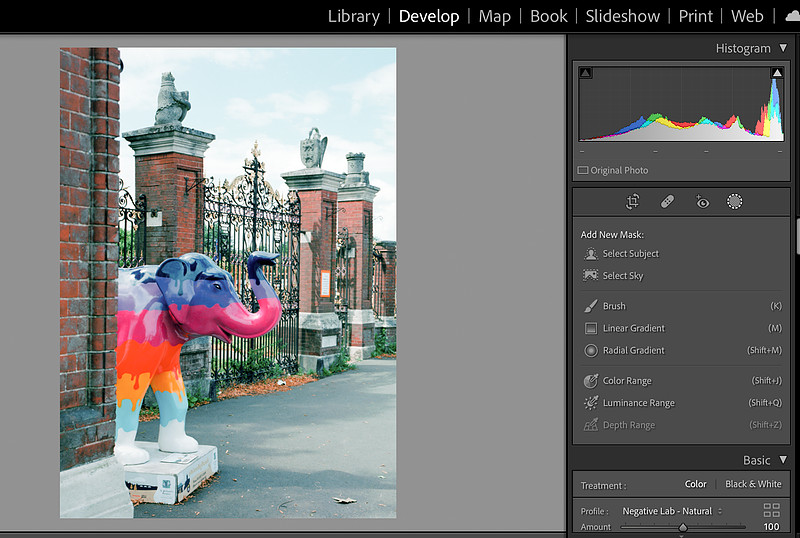
From the Worcester Big Parade 2021, shot on Kodak Ektar. Thought the sky could do with toning down a bit
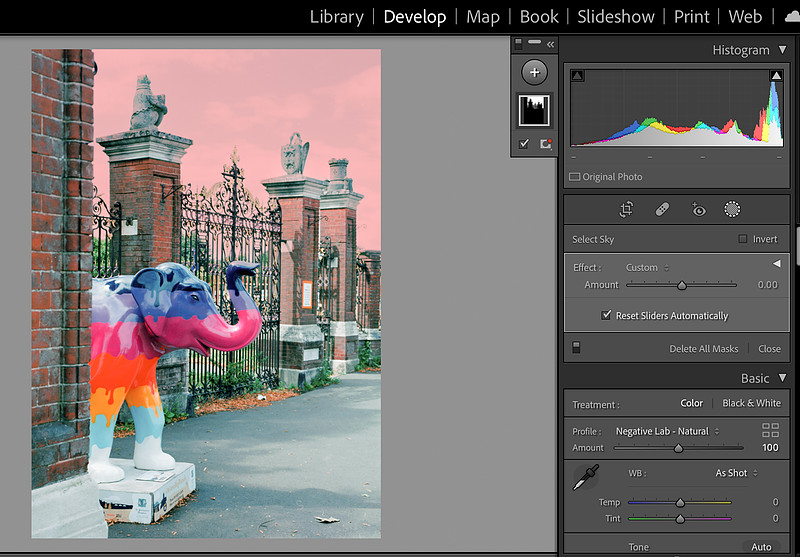
Selecting the sky as an adjustment mask and shown here in pink so we can see the area that will be affected
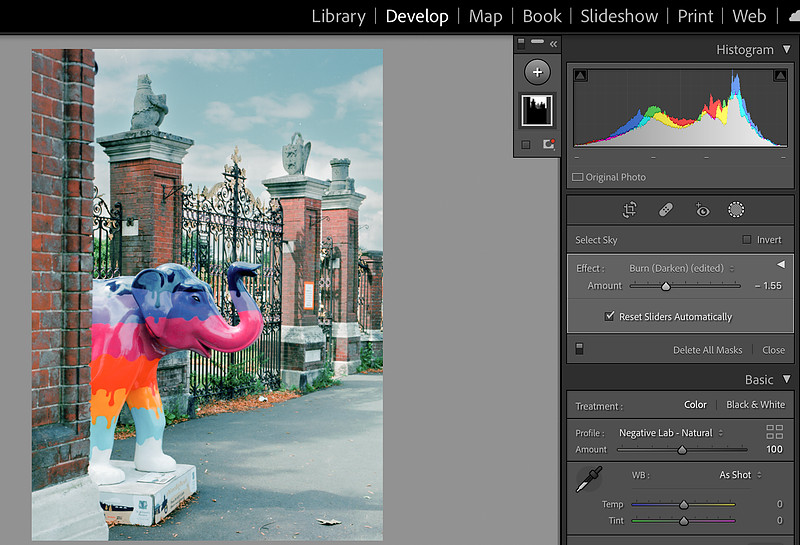
Adjusted image. Note the use of 'Burn' in the menu. Have exaggerated the effect so it's more obvious on all displays These sorts of mistakes can easily be corrected without losing the visual meaning of the original image, or the rationale for taking it in the first place. That’s not to say that I’m against digital art, artificial intelligence adding creative elements or even adding a 1970s polaroid look to a phone shot for social media (although I would personally just buy a Polaroid camera, to be honest). For me, digital art is like any other natural evolution of creativity, as photography was in the 19th Century. Some painters of that era saw this new upstart as bordering on heresy, and some thought it would destroy painting altogether. However, what happened was nowhere near that dramatic. Photography took its position as a bone fide art form over the following 150 years and it’s the drive to explore new ideas and produce something original that has evolved it into what we have today, including the ability to digitally ‘create’. If that’s your bag, then fair enough. Just ask yourself, when your finger hovers over that fancy filter or other creative algorithm, why you might want to over-process and whether it really is a creative decision or merely something to do. The key thing is to create something that expresses your subject or yourself, in whatever form suits your purpose. That’s how we grow as artists. Oh, and ignoring the trolls of course.
Let the light in, but not through thereA few weeks ago, a friend and I visited an unusual location to take some photographs. In the village of Purton in Gloucestershire is a graveyard of small boats and barges that were deliberately beached on the banks of the River Severn during the last century. The idea was to create an artificial embankment to prevent flood water from the river from flowing into the nearby Gloucester and Sharpness canal, at the narrowest point of separation. The resulting graveyard is an eerie but fascinating place, with the remains of wooden and concrete vessels sticking out of the ground. I’d visited before and taken, among others, the image that is on the front page of my website. The plan this time was for my friend to practice his photography skills and for me to shoot some pictures for a series that I’m working on about the reclaimed landscape. His camera was digital and my weapon of choice was my Hasselblad 500c/m. I’ve written about the ‘Hassie’ on here previously, because while on holiday at the end of last summer, it spectacularly failed while I was out shooting in the middle of nowhere (see the post Blad Hassle linked here). I was able to repair it once I’d got back to our rented cottage, but the shoot was a bit of a disaster as a result. I’ve used the camera regularly since then, without any issues. The key thing to remember here is that this camera, although legendary in status because of its optical and mechanical build quality, is nearly 40 years old. It’s never been serviced during the time I’ve owned it, because I’ve found the shutter speeds to be pretty accurate and, as the old adage goes “if it ain’t broke, don’t fix it”. The issue it had in September was traced to one of the three lenses that I have, and I’ve since found that regular use is what prevents that particular problem from reoccurring. We arrived at the ship graveyard and were blessed with plenty of winter sunshine, which I find to be much softer than later in the year. I was shooting Kodak Ektar 100 film, which is the stock I’d selected from the wider series and I had a few rolls in the bag to ensure that I got the shots I wanted. It was a great day, with lots of fresh air, laughs and both of us shooting some really interesting images…or so I thought. A few days after sending the film away to the lab to be developed, I received the negatives. The pictures were indeed good, but they had one thing in common….they were completely ruined by a light leak. For the uninitiated, cameras rely on whatever photosensitive medium it uses to be kept in complete darkness. The only light you want hitting the film, sensor, tin plate, piece of glass etc, should be coming through the lens when the shutter opens. If there is light coming in from elsewhere, it’s bad news. For shooters of ‘didge’, the photo can simply be deleted, an expletive uttered and the camera sent away for repair. For film shooters, it’s a slow and painful burn. I’d shot three rolls of Ektar, which retail at around £16 per roll. Add to that, the cost of developing, in this case a total of £18, I’d just lost 66 quid. The emotional rollercoaster of believing I’d shot some good work, followed by the anticipation while waiting for them to be developed, and finally the total loss of all 36 frames, resulted in a lot of anger and a few tears. So what happened? Well, the Hasselblad 500 series system uses a removable film transport or ‘back’ that the film is first loaded into and then attached to the camera body. As a professional system that was very popular in its heyday, the concept was that the photographer could continuously shoot by having pre-loaded backs ready to go, swapping them out when a film was finished. When my Dad was a wedding photographer, he’d hand his film backs to his assistant, who would reload in the time it took him to finish his next roll of film. I have 3 backs for my Hasselblad, one which came with the camera when I bought it, and two that I’d found on eBay later. In the post-mortem of this incident, I realised that the back was the most recent one I’d purchased, some 3 years ago. It transpired that I’d loaded it with film at the time, shot most of the roll and forgot about it (when I’d got to Purton, I’d finished the 2 frames left on that roll to empty the back ready for the Ektar). What this meant was, the back was untested. On closer inspection of the unit and the negatives from the shoot, I can see that the light is entering the back via a damaged light seal, which is essentially just a couple of strips of foam and plastic. The problem had always been there, but I’d been too lazy to test it beforehand and hadn’t seen the issue in time to save my photographs.
One of the images with the light leak visible
I always accidentally seem to shoot a blank frame (not the camera's fault), which in this case shows the leak in all its glory I didn’t write this post to confess to being an idiot, though (I could have done that in much fewer words). What I wanted to discuss are the pitfalls of buying camera gear online without having the chance to physically handle it. I’ve been really lucky with my collection, in that most of the cameras I’ve bought have met the ‘tests’ that I generally go through. Only on a couple of occasions, has poor information or a rogue seller caused me to receive something that doesn’t work properly. The questions I ask are relevant to both film and digital cameras but are perhaps more crucial when dealing with something that could be decades old. The first question or check that I make is simple enough; ‘has it been tested?’. If a seller indicates that a camera has been ‘film tested’, it’s reasonable to assume that they have gone through the process of shooting and developing. They might add that the shutter speeds appear to all work fine, (which is of course subjective rather than objective) but if they’ve shot with the camera, it would be apparent if there were significant inaccuracies. If the camera has a light-meter and it said to be film tested, even better. Mentions of a recent CLA (clean, lubricate and adjust) are the nirvana; the camera has really been treated well if this is the case. If the seller says that it appears to be working, ask questions to elicit the information above. The second thing I want to know is the condition of the lens (if there is one) that’s being sold with it. If there is any mention of lens fungus (yes, fungus can grow on the glass and its coatings), I always avoid. Fungus can be removed, but it’s costly to have it done properly and you can never be sure that it has been completely removed. There are lots of tales about fungus spreading between lenses in the same bag, but I’ve never seen any evidence of it. If a seller doesn’t provide decent pictures of the lenses or fails to admit to damage, there are routes to return the equipment as ‘not as described’. When it comes to digital cameras, the two additional things I always ask are “how many shutter releases has it had?” and “what is the condition of the battery?”. The first question is like asking how many miles a car has on the clock. If the camera has an electro-mechanical shutter and in the case of a DSLR, a mirror, it’s useful to know the wear and tear on the camera, particularly if it’s getting on bit. Digital cameras came into the fore in the early 2000s, so some of them are over 20 years old now. The good news is that most digital cameras, particularly the higher-end ones, keep a record of shutter releases. The seller should be able to find out how to furnish you with that information. If the camera has been extensively used, there is a risk it might need costly work to repair in the near future. The battery question is a real gotcha. Some camera manufacturers maintain battery designs for many years, for example Nikon have refined the design of the battery for the D6 and D6s cameras, but they kept them compatible with my old D4, which is 10 years old. However, some manufacturers don’t and when they are discontinued, that’s it. In these cases, you need to know how well the battery charges and holds its charge. If it turns out to be a problem after you’ve bought it, the only option may be to buy a third-party battery. This path is very risky, as there are some proper cowboys making batteries these days. Aside from all that, buying used gear is a great idea as cameras are often useful beyond their ‘fashionable’ life. In the case of film cameras, there are some proper bargains out there and with the right treatment, will probably still be working long after we have gone. In fact, most of the original owners of my film camera collection are long dead. Whatever you do, I hope you buy something and start making photographs as it’s very rewarding, even when it goes wrong. In my case, I’ll go back to Purton soon with a film back that doesn’t leak. It’s not as though the wrecks are going anywhere, is it?
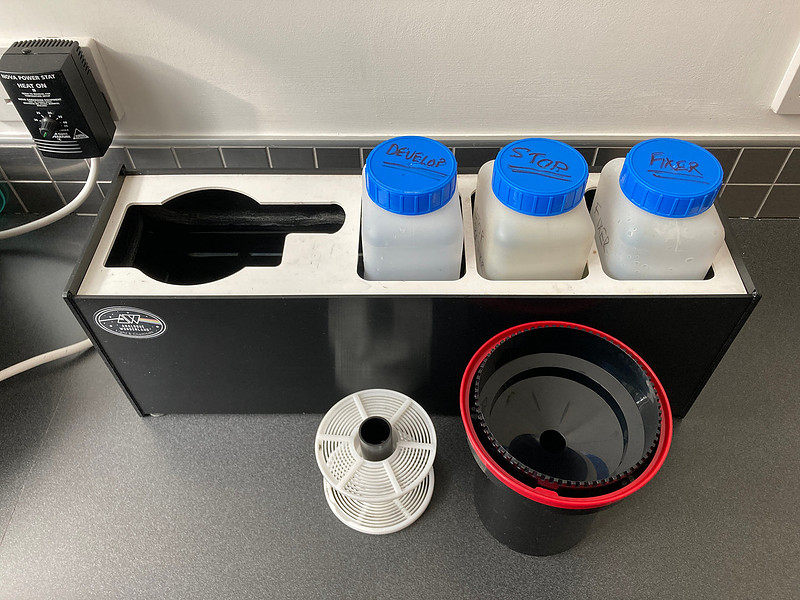
Your mission, should you choose to accept it...Picture the scene. You’re in total darkness, holding a thin, delicate strip of plastic in one hand and a small bobbin that resembles a Ferris wheel in the other. The task that you have to perform is to thread the plastic strip through a gap in the bobbin that is barely wide enough for it to fit through, and fully wind it on. You cannot see beyond the end of your nose and, to make things a bit more spicy, the temperature of the air is rising rapidly and there is no draft to cool it down. It’s getting hot in here, and the success of the operation hangs in the balance. Welcome to a process that can, and in my case has, reduced a grown adult to tears. We are developing film. More accurately we have only just started the process by loading our film onto a developing reel, before we have any ideas about actually recovering our precious images from it. It may seem overly dramatic, but this stage is where many an issue arises. Firstly, our film has previously been exposed to light through the camera shutter when we took the photos and remains sensitive until it is developed, so we have to prepare it in complete darkness. The normal method of loading film takes place in a ‘dark bag’, which is exactly what is sounds like; a light-tight bag that is accessed via a pair of elasticated arm holes. It’s a bit like the bio-hazard box that our movie action heroes use to neutralise the infectious virus or diffuse the bomb, the only problem here being that everything has to be done by touch alone. We must take time and care over handling the film in the bag, avoiding touching the emulsion surface that hopefully holds our prized images, making sure the threading is done evenly so we don’t kink the plastic substrate, and winding slowly so that the film doesn’t jump out of the guides within the reel…etc. This effort in a confined space, makes us nervous, which in turn makes us start to sweat. Did I mention that getting the film wet in any way during this process makes it sticky and much, much harder to handle? Well, it does. So much so, that the ‘film sweats’ is a real phenomenon and I, like many, have suffered from it more than once. The increasing frustration with the now-humid bag, the sticky film and the reel that just won’t wind properly, must be eased somehow, because it’s one of those rare situations where perseverance actually gets you nowhere. When the sweats strike, the only real solution I’ve found is to carefully remove your hands and stick the whole bag in the fridge to cool down. It’s still not ideal, but luck may be onside, and the process might be recoverable. However if all goes well during loading, the reel goes into a developing tank (that’s in the same bag) and sealed shut, so that the actual process can take place in daylight (a darkroom isn’t needed for this process, contrary to popular belief).
Give yourself a pat on the back because we’re halfway there, right? Wrong. If the idea of blindly loading delicate film scares you, wait until you get into choosing chemicals, dilutions, temperatures, timings and all that jazz. Developing film is what could be described as a commitment, that is simple enough in concept but needs practice and care to get right. As the legendary golfer Gary Player pointed out, 'the more you practice the luckier you get'. So, why would any sane person put themselves through this torment the first place? Well, assuming that this question isn’t being asked of a solely digital shooter (that would be stupid), the answer is of course that developing your own film is a rewarding part of a creative process that started when you picked up a camera and chose a film that best matched your ideas. When it comes to developing, there are a variety of options to bring out the creative vision within your images, affecting sharpness, contrast, highlight and shadow, resulting in a crafted piece of work. For example, you could shoot a high contrast scene in black and white, deliberately underexpose the film, and compensate in development in a way that produces a grainy, but dramatic 'film noir' look. Known as pushing film, this technique highlights how the relationship between shooting and processing is symbiotic. Understanding how to process film is one of those specialisms where there is always something to learn and a huge number of resources available, even though film photography is a much smaller undertaking than it was in its pre-digital heyday. Fantastic reference books such as Steve Anchell’s The Darkroom Cookbook, with its custom recipes for developing chemicals, take us right back to our high school chemistry lessons and required a level of competence that I don’t really have (I spent most of my science lessons chatting up the girl I sat next to). However, through trial and significant error, a preferred developer or developers can be settled on easily enough. Some people prefer to use developers that are specifically designed for a film stock and others like to experiment, even developing in a coffee and Vitamin C solution (known as caffenol). My own experience to date has been to gain confidence in black and white development, experiment with pushing film as described before, and trying new film stocks. I dabbled in colour negative development for a short while, which in theory is simpler than black and white in terms of choice of chemicals and developing times, but my results were so inconsistent owing to its sensitivity to temperature fluctuations, that I’ve elected to get them done by a professional lab in future. Fortunately, the rise in the number of people shooting film has resulted in many great labs who develop a variety of formats, so this isn’t a problem to me. I’ve yet to try developing colour positive film (slides to those of a certain age), but I will at some point. Regarding my creative process, the truth is that despite the pitfalls and failures that I’ve encountered developing film, and there have been many, I enjoy the simple pleasure of making something physical. There is something about seeing the film come off the reel at the end, seeing the negatives on a light box for the first time and producing a finished work from them, that is for me more rewarding that downloading a RAW file from a memory card. When I was a kid, I thought of film photography, which was really the only medium available, as some form of magic and the chap in the local chemist who turned my 35mm cartridge into a packet of prints, some kind of wizard. When I develop film now, I still get that slight child-like wonder when all has gone to plan.
Attention!, shot on Kodak TMax 100 film in the Hasselblad 500c/m, developed by Yours Truly My process, like many who don’t have a darkroom, is to scan the developed film and print from that using an inkjet printer. This may seem like heresy, or some might question the decision to move into digits after all that analogue stuff, but to be honest it’s a convenience more than anything. Although film is enjoying a revival and new stocks are being released or discovered faster than the discontinuations (I’m looking at you, Fujifilm), there has been a decline in printing papers that makes creating a darkroom seem a little limited to me. This is just my opinion though, as I know there are people taking up wet printing in community darkrooms, which I do think is a great idea. It’s just not for me. You may be wondering why I’m writing about this now. Well, a nasty bout of Covid-19 has somewhat cramped my style this past couple of weeks, so I’ve been using the time to work through my backlog of film. I should really stay on top of it to begin with, but life does have a habit of getting in the way. Each roll I develop yields photographs that I’d almost forgotten about, which is a nice surprise when you feel a bit under the weather. I would hardly describe the process as therapeutic, though. It’s enough to make Mr Bond sweat.
The Need for CalmIf you’re wondering why I’ve neglected this blog for a couple of weeks, the answer is that things have been fairly chaotic here as they always are at the beginning of a new year. As most readers will know, I’m currently studying for a photographic degree via distance learning, which is definitely a marathon rather than a sprint. The course is structured to run over several years rather than the 3 or 4 year full-time equivalents that ‘bricks and mortar’ universities offer. While this might seem like a drag, which is in fact the reaction from most people when I tell them how long each unit is, I actually find that it has many benefits. The first is the obvious one: I can fit it around everything else that goes on in daily life. I’m no longer working a 9 to 5 job, but that doesn’t mean that things are quiet; life has the habit of getting in the way at times. The second benefit is far more important though, in that it offers the opportunity to take time to learn and evolve as a photographer. Studying largely by myself, I can delve into much more detail on any genre or practice that interests me than I would be able to if I was attending classes every day. There are disadvantages too, which I won’t bore you with beyond talking about the reason why the first two months of every year are chaotically busy. It’s assessment time again. What this means is that having completed a course module within the allotted time, the work needs to be prepared to be formally assessed at one of three ‘events’ during the year. Owing to the timing of when I started the degree, mine always falls in line with spring assessment, which is held in March. In practice, assessment is a fairly straightforward process, involving selecting work that represents what I’ve learned, ensuring that all feedback and reflection has been accounted for and general admin. What it means emotionally is a different story. The killer questions that I ask myself are “have I done enough?” and “is the work good enough?”. As the deadline looms, there are always difficult decisions to make about the work like sacrificing one or two favourite images or pieces of work if they don’t create the right impression with the assessors, for example. Eventually, after lots of stress and affected sleep, the submission is complete and everything goes quiet. It is in this quiet time that I now find myself in reflective mood.
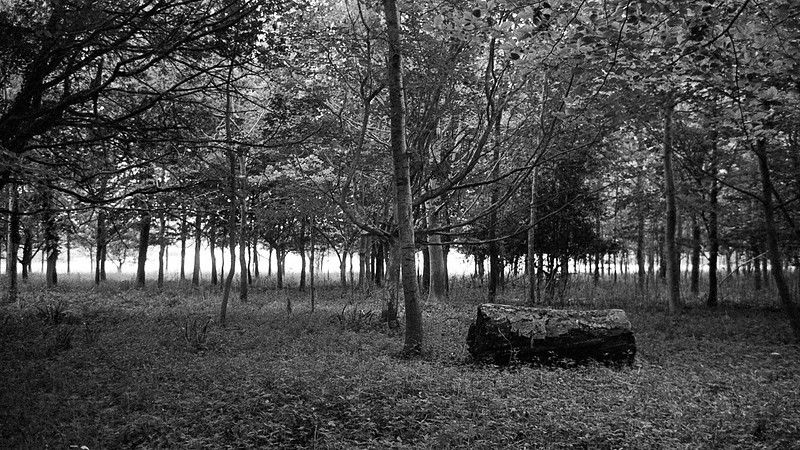
Wood for the Trees, R Fletcher (2021) This past year has been a creative challenge for a number of reasons. The main one being that as the course progresses, the work becomes more engaging and as a result, more challenging. It should naturally be harder, right? I don’t think I was prepared for the amount of research I would need to do in order to understand the key concepts, nor did do a particularly good job of managing the time spent on it. When it came to the main project for the unit, I chose a subject that both fascinates and horrifies me in equal measure, the modern phenomenon of internet trolling. While I was aware of how corrosive this behaviour could be, it wasn’t until the research and planning stage of the project that it started to get under my skin. At first glance, the characteristics of the average troll were socially isolated, often lonely people, who saw the lives and opinions of others to be in such contrast to their own, that they felt the need to protest in some way. I’ve talked before about the trolls who attack charities for the way they spend money, the decisions they make around who or what they support, how much their CEO gets paid etc…etc. When I first saw this appalling behaviour, I thought I’d seen it all but I was wrong, of course. There are plenty of well-known cases of cyber trolling being so bad that the victim self-harms or, worse still, takes their own lives. While researching the subject, I wondered how these awful perpetrators slept at night, knowing the damage they were doing. Then it dawned on me that they are actually insulated from the effects of their actions. The anonymity of the internet gives everyone the opportunity to offer an opinion or comment in whatever way they like, citing ‘free speech’ as the excuse for their behaviour, however abhorrent. The continued rise of the low editorial value, right-wing media outlets that rage about the erosion of free speech, makes it even easier for trolls to disregard the impact on their victims because of some sense of entitlement. Even after wading through a great deal of this unpleasantness, the most shocking realisation was yet to come; everyone is a troll in the making. Unlike my first assumptions, the troll isn’t some societal outcast at all. Instead, their kind of behaviour can surface when any person is undergoing personal stress, prolonged isolation from people or feeling the loss of what is familiar to them, however small or insignificant. A friend of mine was telling me recently of a neighbour who couldn’t be nicer in person face to face, helpful and kind etc, but when they went on social media, they turned into an angry racist bigot. They were apparently unaware when triggered by something they didn’t like online, that their comments were being read by people who actually knew them. The result was a sort of Jekyll and Hyde character that my friend now consciously avoids whenever possible. Given the problems that have surrounded us in the world this past few years, it’s hardly surprising that trolling is increasing as a mechanism for letting off steam. While I understand this, all I knew was that my already challenging photographic series now had a sinister side to it, which was tricky to navigate. I also found the research very emotionally damaging, which I think came through in the final series. Why am I discussing this here? Well, since the unit completed, I’ve sought to find some measure of calm before the next course starts in a week or so. I’ve spent some time taking photographs, thinking of new ideas for series and generally getting my creative head together. I’ve also had to respond to some ongoing health concerns by completely overhauling my diet, which has helped me relax and given me more energy. Training for my 12km swim in the summer has also intensified, which also seems to help. What I’m getting at here, is that there are much healthier ways of finding calm than ranting on the internet, particularly at the detriment of others. We’ve all heard the mantra “be kind to yourself”, but I wonder how many of us actually do just that. Finding another outlet for our frustration or anxiety can only be a good thing. How do you find calm? Let me know in the comments. If you haven’t seen my series Modern Monsters, you can find it here: https://www.youtube.com/watch?v=OCouCCUDXog&t=5s For more information about personalised tuition, please email me at [email protected]
Believe It or NotThe past week has seen me reach an important milestone, apparently. Bizarrely, it appeared more important to other people than to me, but it is a special feeling to know how many people care about you. The milestone in question was my 50th birthday. As usual, I had no idea how to mark this seemingly momentous occasion, because I’m not a stereotypical party animal and I lack the patience to organise anything that resembles one. As with previous decades, I’d elected instead to do something low key and in the case of the day itself, something different. After several failed attempts at booking, I managed to get onto a care and rehabilitation course for my one of my favourite wild animals, Erinaceus Europaeus, better known as the European Hedgehog. Those who know me well, will be aware of my obsession with these little creatures, caring for a number in my garden and working with local rescues etc. This course was going to teach me everything I needed to know about their basic medical needs for the next time I found one unwell or injured; I can tell you that for such a seemingly simple animal, there is a great deal to learn. Although aimed at everyone from ‘well-intentioned do-gooders’ like me to veterinary professionals, the course was also a useful source of information to debunk myths surrounding the humble hog. As with all subjects it seems, there is a great deal of bad information out there, which for some reason permeates into the general public’s thinking and soon becomes gospel. They don’t have to have any basis in medical science, nor in some cases any simple common sense. The best example given by the course tutor was somebody that confidently claimed on social media that “if you feed hedgehogs fish-flavoured cat food, they develop a taste for it and will subsequently take all the goldfish from your ponds”. We all found the notion of an animal that lacks real intelligence (being purely instinctive) identifying a flavour, associating it with another creature, observing where to find them, and teaching itself to fish, absolutely hilarious. It is of course total nonsense. Hedgehogs don’t generally like the flavour of fishy cat food and will often leave it in search of something more in line with its natural diet of insects or invertebrates. If you put it out for them, it’ll likely still be there in the morning unless next door’s cat fancied it. I got to thinking about these nuggets of pure fiction that we encounter every day. How did we get to the stage where everyone with a strong opinion on a subject can potentially remain unchallenged enough for people to buy into it? It would be easy to blame social media for this phenomenon as this is where the majority of these things crop up these days. Having just completed a piece of work about internet trolls, I’ve been shocked at the prevelance of ‘you’re wrong and I’m right’ attitudes that are aggressively published for all to see. Some people take these trolls on, but most simply ignore them. However, this isn’t a new phenomenon unique to the digital world. Newspaper media, television and radio all have platforms that offer the audience the opportunity to take part in a debate or voice an opinion. The difference for me is the scale and accountability between the platforms. For example, if an opinion is presented on Question Time, the programme’s time constraints and the stewardship of the presenter, adds some control over any debate that arises. The discussion concludes and everyone moves on. However, the same things don’t exist online. If the consensus of views grows sufficiently, and has a glimmer of credibility about it, some form of mythology can become established. Another example in the hedgehog world is around the predation by badgers pushing their numbers to the brink of extinction. Not only are there fewer badgers in the UK than hedgehogs, but the latter is actually considered a stable population across the European region, so the idea of extinction is wildly inaccurate despite their decline in the UK. I mention this example, because until the course I attended and some subsequent research, I believed every word myself. The same established ‘ideas’ exist in the world of photography. I was listening to an interview with Nan Goldin recently about how she wasn’t accepted within the photography establishment in her early years. Goldin’s famous work The Ballad of Sexual Dependency, was severely criticised for being poor quality, badly lit, composed etc., because of her prioritisation of her subject over the technical aspects of the medium. She freely admits to not being interested in camera gear (or the people who obsess over it), calls herself an artist rather than a photographer and confessed that it wasn’t until the 1990s that she learned about the different qualities of light. We can see this in The Ballad images, which largely use flash to achieve exposure and emphasis large blocks of colour because that suited her vision at the time. Many years after the establishment rejection, The Ballad is one of the most revered photography books of all time, because the style of the images supports intimate narratives about the artist and her close relationships with her friends. Similar issues surrounded Julia Margaret Cameron and her unconventional way of representing her portrait subjects over 100 years ago. Both women were subjected to judgement by the male-dominated art world, but that doesn’t completely explain their experience. They worked differently to other people, which took a while to penetrate the ‘rules’ that had developed as the medium evolved. Even now, photography is subject to lots of ‘rules’ and established ideas that almost determine whether the viewing public rate an image or not. For example, there are plenty of Instagram ‘hacks’ that promise to make our phone images better, but in actual fact they are making them more like the other successful photographs on that platform. Is this necessarily a bad thing? Of course not. The internet has provided us with a huge repository of learning material, which helps us improve our photographic practice. What I’m saying is that I don’t accept that there are rules in photography. For example, including a foreground subject in landscape makes it a more interesting picture than an empty vista. It gives the eye something to ‘notice’, perhaps in the way it contrasts with its surroundings or to establish a sense of scale. However, as I mentioned in a previous blog post, there are different creative ideas around landscape and how it is represented in art. Doggedly placing structures or objects in the foreground of a picture tends towards the picturesque, neither emphasising the beauty or danger (sublime) quality of the ‘view’. So, sometimes rules steer us into a particular style of image that is widely accepted by the viewing public, when that might not be what we originally intended. Again, this isn’t a judgement. I recently selected some landscapes from my collection to show a beginner and was dismayed to see that they all followed the picturesque composition style, rule of thirds, leading lines…blah blah. I look at them now with the benefit of further learning and realise that they don’t convey what I was trying to represent about the scene in front of me. When I ask people why they shoot a landscape with their phone, the answer is usually “because it was beautiful”. I see a lot of these epiphany images on social media, and they generally grab the scene as quickly as possible, without emphasising the thing that appealed to them in the first place. Composition ‘rules’ then, help us construct the image but it’s more important is asking ourselves ‘what am I trying to say here?’ If the answer is light, then make the light the dominant element, if it’s the calm sea in the foreground, work with that instead.
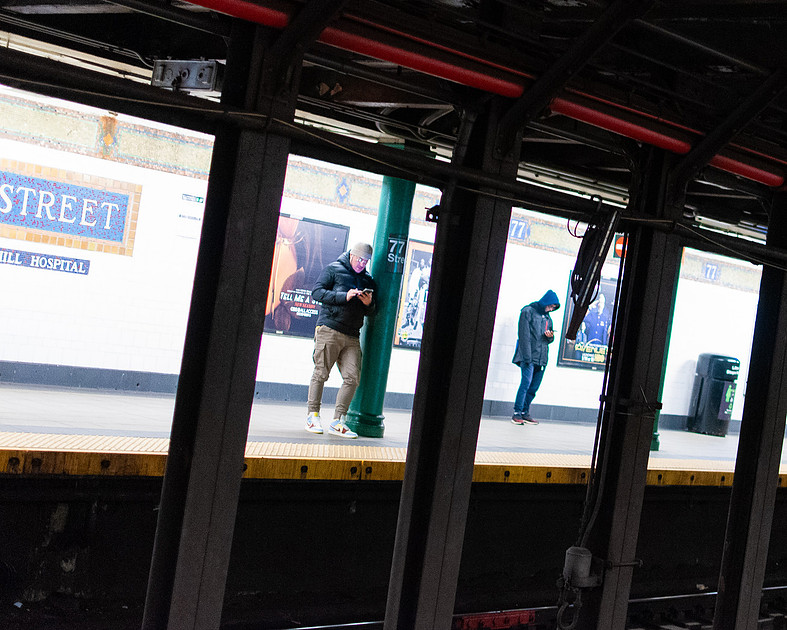
NYC 2020. All about the people rather than the composition In my opinion, the real evolution in photographic art is when artists ignore the rules. It could be Francesca Woodman’s or Lee Friedlander’s unconventional self-portraiture, where the artists placed themselves half out of frame or reflected in a mirrored surface, or the New Topgraphics movements highlight of the impact of manmade on the natural world. Whatever your motivation for creating, don’t believe everything you read (including this, of course) or what is thought to be established practice, particularly if it interferes with your idea. Just try to use your camera to reveal what you want to show to the viewer and beware the confident expert who tells you that you are wrong. Now, I’m off to buy some organic vegetable catfood…hedgehogs like that, don’t they? |