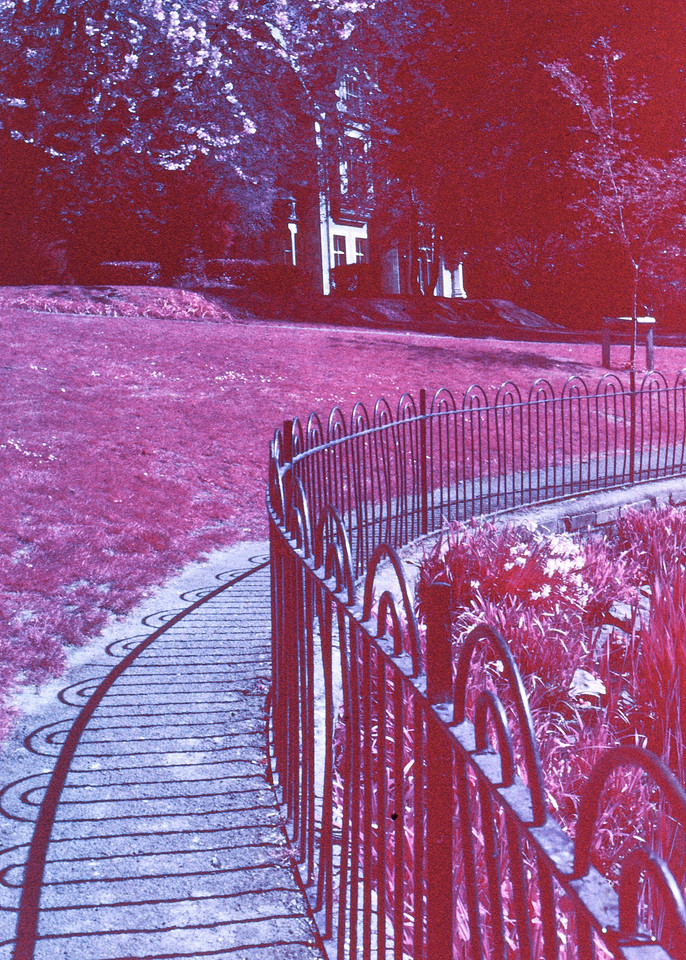
“Just write every day of your life. Read intensely. Then see what happens..."Ray Bradbury on writing Ok, so there won't be a post everyday, but this is where I'll be sharing short stories about my adventures as an artist and student. Check back here for the latest updates by clicking the subscribe button below. Expired Infrared Ektachrome Fail and LearningA couple of years ago I had a momentary loss of my faculties and bought 3 rolls of what is probably the most rare and mysterious film stock out there. Kodak Aerochrome is a colour infrared (IR) film that was originally designed for military use in locating man-made objects hiding in vegetation. The film renders organic materials that naturally reflect light in the IR spectrum as varying degrees of bold, mainly red colour where artificial materials generally look similar to how they do in visible light. In short, any plant or tree life looks like something out of a science fiction movie, while man-made stuff like artillery and camouflaging don’t. The film found other uses in airborne survey of vegetation after the military need diminished, but eventually Kodak called time on the film in around 2010. Since then, photographers and film-makers have used the remaining stock to create beautiful, other-world artworks. As the film became rarer, the laws of supply and demand drove up the price to an eye-watering $40 per roll (back when I bought mine). I grabbed my 3 rolls and put them in the deep freeze until I could find a subject. Then came the pandemic and my priorities changed. The film is ideally shot during the summer when the intensity of the infrared in the sunlight is at its highest. Once the summer of 2020 had passed, I resolved to shoot it in 2021. As the film was in the deep-freeze, it wouldn’t dramatically age during that year…unlike me. Once the impact of the pandemic began to ease towards the end March 2021, I thought I would have a go at shooting one of the rolls during a brief period of bright, sunny weather. I selected my Nikon F6 to shoot it in, having first checked that it would work. Lots of film SLRs used light emitting diodes (LEDs) to determine how far the film was being advanced with each frame shot and this is a big problem with IR film. These lights emit sufficient light in the IR band to fog the film before we even start. The F6, being a professional SLR didn’t suffer from this problem and it had the additional benefit of having a very accurate light meter. I thought this combination would be a winner. After loading the film in the dark…yes, even loading in normal light can fog the film inside the cartridge, I was ready to shoot. I went to the local park to find some compositions that would include vegetation and man-made structures to really bring out the legendary look of the film. Once done, it was just a case of waiting for the lab to develop them. When it comes to processing, the film is a positive slide which needs to be done as E6 process. Anyone who grew up in the 1970s will remember sitting around a big screen looking at slides of someone’s holiday photos. Tedious slide marathons aside, in my opinion there is no more magical a film than a positive slide. Anyway, the IR film can’t just be put in a processing machine for similar ‘LEDs-ruining-everything’ reasons as mention previously. My lab uses a manual process that was established as safe for colour IR. With all of these elements in place, I was confident. How wrong could I have been? When the film came back, the clearest issue was that they were all under-exposed. The film is expired and although it had been tested, I didn’t take the age of the film into account. There is a school of thought that says that if you’re using expired film, you need to over-expose by 1 stop for every 10 years by its expiry date for negative film. Wasn’t sure this also applied to positives. Perhaps I was instinctively worried that if I deliberately over-exposed to compensate, I would then run into the well-known narrow dynamic range associated with positive slide films - slides are notoriously stingy when it comes to exposure and demand to be spot on to get good results. Whatever the reason, there is nothing worse in film photography than under-exposed slide film and that is what I had.
When I look at these shots, I can see the desired infrared effect. However, the shadows are a mess. I used matrix metering on the camera to get the average meter reading based on the dynamic range of the scene. The loss of shadow detail and the weird grain that appears points to the exposure being well off. Like all film fails, it’s hard not to ask other questions. Was the film any good to begin with? Did the camera work properly? Did the lab screw up the processing? I started to think about these other possibilities. Taking them in turn, the film came from the brilliant Film Photography Project in the U.S. and they in turn got it from a vault in a military facility. It had been stored properly by both parties and the FPP did their own testing on the batch before they hand-roll it. I find it hard to blame the film knowing how it was handled all the way from the various freezers to my camera. As for the camera, my F6 is only a few years old and has worked perfectly with every other roll I’ve shot through it - so I guess that’s not it either. That leaves the lab, which is an easy target and people often pin their photographic failings on the poor technician who processed the film. I can’t find any variations between the frames on the film and the image structure is present in each. No matter how I look at it, this was my issue and not theirs. One thing I’ve learned about film photography is that it pays to be humble about one’s own shortcomings when things go wrong rather than try to blame something else. Sometimes, you just get it wrong and the consequences as well as costs are yours alone. What I’ve learned about this first roll and this experience is that trying something different and being prepared to get it wrong is a positive thing. I had to look past the cost of the roll, admittedly through my tears, and see what I would do differently next time. More research into shooting expired slide film and even waiting until the proper summertime conditions would be top of the list. I would also think about developing it myself if I can get some E6 practice before then. What I know for sure is that I can’t wait to have another go. With a holiday coming up, perhaps the stars will align next time.
The Pointless Debate - Film or Digital?I heard an age-old debate on the radio recently about the acceptable order of applying cream and jam to a scone in a traditional cream tea. I had to roll my eyes a little, firstly at the idea that a whole radio segment could be created from something so trivial, but also that there is of course no ‘correct answer. The order of things depends on a personal preference that is often driven by local traditions passed down through families. Since I have no connections with Devon or Cornwall, I’m not taking sides here because frankly, I don’t care as long the scone has both. It got me thinking about a similarly over-debated idea of which is best, film or digital. For me, this discussion used to rage between a colleague and I several years ago. He was a traditional medium-format film photographer and I had just acquired my shiny new DSLR. Naturally, my Nikon D4 was the best camera I had ever seen, technically advanced but relatively simple to use and with a passing resemblance in size to a Howitzer anti-aircraft gun. I wasn’t going to hear a word against it or digital, besides which I hadn’t shot any film since I was a teenager and that is further back than I am prepared to admit. When I did use it, I remember the excitement that I felt as I rattled through roll after roll, followed by the crushing disappointment when they were processed and found to be utter rubbish. Digital was cool, you could see the results instantly and didn’t have to suffer the ignominy of the photo lab putting a sticker on your prints telling you where you went wrong. My colleague was having none of it. In his view, the look of a picture shot on film and the subsequent wet print made from the negative could not be matched by what was essentially a computer. He was fully involved in the creation of his work, processing the film and making prints in his darkroom that he then sold online. Not surprisingly, his work is excellent because he is very skilled at his craft, but I was adamant that it was an outdated medium that ‘progress’ had killed off. In my defence, I was young(er) and stupid(er). About 5 years ago, I was inspired to shoot film by a chance meeting with a famous American photographer. The inspiration wasn’t just some silly hero-worship, though. What resonated with me during our brief conversation was the idea of slowing everything down and concentrating on being in the moment. Although this could be achieved with a digital camera, nothing focused the mind quite like every frame costing actual money. Also, many of the available film cameras were entirely mechanical, which meant that in addition to avoiding bankruptcy an actual knowledge of the craft itself would also be important. The impact of these factors grew with the type of film being used. A 35mm film might be cheap enough at around 20 pence per frame, but 8x10 inch film for a large-format camera can cost an eyewatering £20 per frame. Add processing to that and you have a significant investment in your art. I started out by buying my first medium-format SLR camera, a Hasselblad 500c/m, from a faceless stranger on the internet. Although the risk of parting with my hard-earned money on something I had not seen or tested hadn’t really registered, I was to learn as I collected more film cameras that care was needed here too. Old cameras like any machines require looking after and being maintained properly, otherwise they can fail. Fortunately, my Hasselblad is a good condition camera and the very first roll of Ilford FP4 I shot yielded some images that began luring me into this analogue world that I had previously been reluctant to accept as being anything but dead. From there the next stage was ‘developing at home’, a similarly magical pastime full of excitement and anxiety and therein lies the thing. I hadn’t appreciated the variability of this medium. Film is made by a chemical deposition process to a recipe. Each emulsion is created to achieve a certain sensitivity or speed, tone and contrast and the way they look when exposed can vary significantly. I learned about how film grains vary in size, how film ages and how that affects its performance, how there is exposure latitude in some stocks more than others and how the response to light is non-linear during long exposures. I then learned that the choice of chemicals to process the film, the temperature, timing, etc also made a huge difference to how the shot would look as well as whether there would even be a usable image to begin with. Yes, all of this appealed to my engineering curiosity, but the big learning for me was the need for total concentration from the moment you load the camera to hanging up the film to dry. It’s the pace of film that really appeals, standing in a field looking at a beautiful landscape or piece of architecture and thinking through the shot. Will I shoot colour or black and white? If the latter, how will the highlights and shadows translate onto the film? Will the ghost of Ansel Adams help me with interpreting his Zone System to get the most out of the exposure? The old adage of ‘measure twice, cut once’ never seems so right as at the moment of releasing the shutter. Once it’s done, all you can do is wait. After 5 years of playing with film, I can honestly say that I love it. My enjoyment of shooting it has driven my passion to improve as a photographer and the more I learn, the happier it makes me. More widely the resurgence in film photography, particularly in the younger generation, is encouraging the development of new film stocks such as Lomography Metropolis and Bergger Pancro and even the re-introduction of classics such as the legendary Kodak Ektachrome. This medium in photography seems to be alive and kicking. Young people are getting hold of their parents’ old cameras (they don’t use them anymore so they must be cool, right?), cruising charity shops, car boot sales and eBay for anything to shoot with. I was in London last year during one of the brief respites from the pandemic and I saw a young man walking around the streets carrying a Mamiya RB67 around his neck. Now that is a camera that makes my D4 look like a compact! The camera and film market grows healthier every day in the hands of these people and I for one am a fan. What does this have to do with cream teas? Well, I learned that film was something very special and continue to be inspired to shoot it, but that doesn’t make me a better photographer. It isn’t better than digital nor is the opposite true – they are just different. Everything I have learned about composition, light and meaning can be achieved just as easily with a digital camera as with film. In the end, it really isn’t anything to do with the gear but the creativity of the artist in control of it. I’ve seen amazing work shot digitally using state-of-the-art cameras, on film using a van converted into a giant pinhole camera, and on a humble mobile phone. In equal measure I’ve seen some awful photographs made with all of three types. For me, creativity is about having an idea and using whatever tools you have available to help you realise that idea. As long as you get your cream and jam, it doesn’t really matter how you get there.
Newer Posts »
© All Images are the copyright of Richard Fletcher
|